What If You’re Not Too Much? Learning to Use the Parts of Yourself You Were Taught to Hide
What if the parts of yourself you were taught to see as “too much” are actually the parts you’re supposed to learn how to use?
Part of me wants the world to see me. Another part of me wants the world to understand me. Thus, my life is a paradox. I am wired for visibility and creating something that positively impacts the world. AND, I battle the core questions: Am I good enough? Am I allowed to take up space?
People often tell me that I’m intense. For a long time, it left me stuck in a cycle of wondering, is that a good thing or a bad thing? Am I too much? Do I need to dim my light and hide pieces of myself to fit into this world?
Here’s the story of how I’ve learned to become comfortable with the fact that people perceive me as intense.
I was just 12 years old when I decided I would have a talk show and inspire people. It was never, “I want to.” It was, “I am going to.” Simply a matter of fact, with zero doubt in my mind. I never thought to consider the many barriers it would take to get to that moment, because I knew I had it in me. This was right around the time I started my original blog on WordPress.
While other girls in middle school were meeting boys at the ice-skating rink on a Friday night, I was at home, writing. I was writing blogs, stories, and business plans. I was already working toward my future. I was, in my mind, already changing the world.
What most people misunderstood about me was that I wanted to be successful, AND I wanted my success to help other people. It was never just about me. It was always about contributing to something much bigger than myself. You see, I didn’t have the language for it yet, but I was struggling with depression. I had an inclination that my life would be cut short, so I kept working toward leaving an impact behind. To me, I was building my legacy, turning my core wound of not being enough into a source of wisdom and healing for the world I thought I’d leave behind.
I got branded as intense pretty young because I took, and often still take, everything seriously. I considered every consequence that could come from any behavior I engaged in before acting. In this situation, if I do (x), then (y) will happen, but if I do (a), then (b) will happen, but… My life was already a chess game, where I was trying to calculate the next move by understanding what move could come next. And how exhausting that was.
The fundamental desire I was chasing was love. Something inside me wanted to be deeply seen to earn love, while the surface part of me, fueled by what-ifs, wanted so badly to hide anything that could take that love away. I didn’t know love was designed to be unconditional. I decided it was something to be earned and something to be lost.
I think that started when I was celebrated for my good behaviors and perfect outcomes, and punished for the mistakes and shortcomings. The difference in the response between a 100 and a 90 was massive. One was an A+, meaning excellence, while the other was just an A, meaning improvement was needed.
So, teenage me grew up in an array of confusion. “I need to shine,” but “I need to be useful.” Every problem needed a solution, and I had to be the one to find it. In fact, I had to anticipate the problems before they arose and solve them before anyone had the slightest inkling that something was wrong.
My emotions became a weakness in the eyes of analysis. Life was not a space to process emotions; it was a space to suppress them. I loved math and science, so I formulated life in equations and experiments.
Identify the problem.
What is the control vs. what can I do?
Hypothesize: What does this mean? How do I fix this?
Experiment: What’s the next step?
My emotions, my problems, and more importantly, everyone else’s problems and emotions were meant to be analyzed and extinguished.
But the more my life became a chess game that I was determined to win, the more intense I became. It wasn’t about doing my homework or studying for a test; it was about getting the highest score. I cried, I hyperventilated, and I studied all day and all night. Anytime I fell short of a 100, I panicked. Anytime I could not find the solution, the world was ending.
I was a competitive cheerleader growing up, and most people believe childhood sports are fun and absolutely not that serious. However, there I was being taught to tumble one-handed because I had a cast on my arm, being discharged from the hospital on morphine to make it to practice on time, and tearing eight ligaments between two ankles an hour before competing, only to be taped up, braced up, and pushed back onto the floor.
I never considered a world where rest was an option. It was about perseverance, determination, and becoming better.
Years later, I’m still learning this lesson. I recently fractured and detached two ribs, and almost a year later, I tried to lift three-pound weights at the gym and the injury recurred. I detest exercising because my body still shuts down and injures itself. And yet, I still don’t allow myself to rest. Instead, I get angry at myself for not being better.
In college, I heard someone graduated in three years, and of course, life became a competition and I had to be better. I graduated in 2.5 years while working 50 hours a week between two jobs, taking 4 a.m. shifts and evening shifts. I barely slept, barely ate, and was running on empty for years. I’d stay up most nights vomiting from anxiety about my schoolwork and exams, struggling to manage existing and succeeding.
There are many more examples, but that’s not what you’re here for. You’re here to learn what changed.
I ended up in a psych unit after trying to end my life three times. I was living in an internal battle of hating myself while trying to better myself so I could finally love myself. I lived in a dangerous cycle.
Achievement → temporary validation → new standard → more work → achievement → temporary validation.
I needed to do more and be more so people would see me, and I’d finally feel okay. And then one day, I was just completely exhausted. The voice in my head was a broken record of, “You will never be good enough,” no matter what you do or how hard you try.
So, I just stopped. I paused, and I changed the questions I kept asking myself.
What am I known for?
What am I building?
What will my name become associated with?
What contribution will I leave behind?
I love these questions, but I was coming from a place of intense pressure. I was never making space to understand myself, who I was, and who I could become.
So, I reflected on the paradoxes within me:
Am I doing this because I care, or because I need validation?
Why am I exhausted when I supposedly love what I’m doing?
Why do I want to be seen and then immediately want to disappear?
And then I rewrote the questions.
Why does helping people feel so central to my identity? Why do I feel compelled to build things rather than simply participate in them? Why might recognition matter to me more than I want to admit? Why can I become obsessive about making a vision actually happen? What does success actually mean for me? What am I potentially building toward over the long term?
Those questions changed something for me. The pieces of me that felt “wrong,” the intensity of my drive, my goals, and even my desire to control outcomes, were never the problem. The problem was the fear attached to them.
I didn’t need to become less ambitious. I didn’t need to stop caring. I didn’t need to make myself smaller or quieter. I needed to understand why I was doing what I was doing and separate my worth from what I could accomplish.
It is no longer a question of, “What am I worth and who gets to decide?” It’s a statement.
I am worthy. No question, no parameters, no ability to lose it.
My emotional values, the parts of me that once felt broken inside and didn’t see a lasting future, and my actions are connected to a deeper meaning. I’m interested in my work, yes. And more importantly, it matters to me. I’m not creating because I need to prove that I am enough. I create because there are things I believe should exist in the world.
So, I follow inspiration, I feel, I create, and I dream. I completely immerse myself in my own creativity.
With every push, with every laugh, with every late night dreaming, I have become whole in my world. I do the things I love. And my intensity is not a problem to be solved.
It is part of how I protect who I am and what I do with my whole being.
Maybe the goal was never to become less intense. Maybe it was to become comfortable being fully myself.
I am creating what will outlive me. And I am going all in because I believe so deeply in myself. The way I breathe into this world is taking a creative concept, building a practical tool, and exhaling a collective impact.
If you battle an internal paradox, if you struggle with the fear of being too intense, or if you feel forced to hide pieces of yourself, I built a practical tool.
It’s called Pieces of You, and it’s a space where every piece of you belongs. In that space, you are free to reflect, express, and connect with yourself and with others.
Because healing isn’t becoming less of who you are. It’s learning what to do with all the pieces of you that you were once taught to hide.
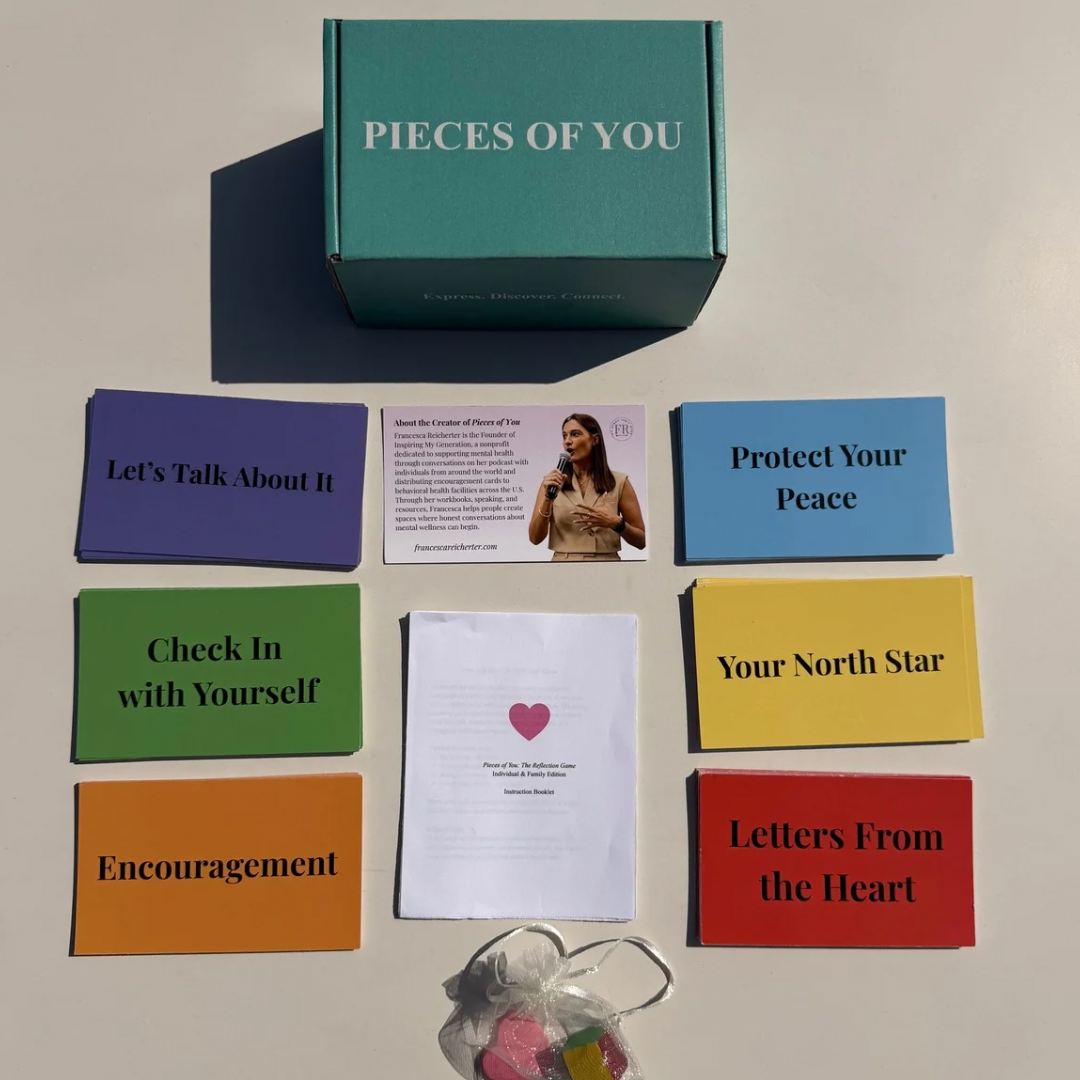
Pieces of You™ (Individual & Family Edition) is a card game containing six different categories of prompts to help you slow down, reflect, and connect. The game can help guide conversations while inviting you to explore your thoughts, emotions, values, and experiences in a thoughtful and supportive way.
You can use these cards:
for personal reflection
as journaling prompts
during meaningful conversations
with friends, family, or partners
Recommended for Ages 10+
Learn More: Pieces of You: The Individual & Family Edition — Francesca Reicherter
© 2026 Pieces of You — All rights reserved. Pieces of You™ — Pending USPTO registration.