The Versions of You That Don’t Make It to the Next Chapter
There are versions of me I can still picture so clearly that it feels as though I could step back into their lives if I knew which door to open.
I remember the cheerleader who measured a good day by how hard she could push herself, the college student who worked full time while racing toward an early graduation, treating exhaustion like an inconvenience rather than an omen, and the girl who found herself in a psychiatric unit, trying to understand how a mind capable of imagining so much possibility could become a place she struggled to survive.
Later, I became a caregiver, flying across the country while pursuing my master’s degree, learning to carry responsibility into unfamiliar places while trying to keep my own future from slipping through my hands. Somewhere between those chapters, I became an entrepreneur, a writer, and a person who could take an idea that existed only in her imagination and make it tangible enough for someone else to hold.
Each version feels like a different lifetime, although every one of them belongs to the same life.
Sometimes I wonder what those earlier versions of me would think if they could meet the person I am today. Would the cheerleader recognize the determination, or would she be surprised by how much I have learned to relinquish? Would the college student understand why I no longer measure every hour by what I can accomplish? Would the girl in the psychiatric unit believe that the future she could barely imagine would eventually contain so much life?
Perhaps the more unsettling question is what I would say to them, knowing everything they had yet to experience and everything they would eventually have to leave behind.
Life has a peculiar way of closing a chapter while we are still trying to decipher the last page. We spend years constructing an identity, laying brick upon brick until we believe we have finally built something permanent, only to discover that life has been quietly changing the blueprint while we were busy admiring the architecture.
Circumstances shift. Priorities become unrecognizable. The future we once pursued with almost religious conviction begins to resemble a destination we may never visit. Sometimes, the life we worked so diligently to build becomes a place we have outgrown, and the hardest part is admitting that we can no longer live there simply because we remember what it cost us to arrive.
For a long time, I understood growth as accumulation: more knowledge, more accomplishments, more experiences, more evidence that I was becoming the person I wanted to be. Progress seemed to require an ever-expanding inventory of things I could point to as proof that I was moving in the right direction.
I rarely considered how much of becoming someone new requires the quiet dismantling of who we once believed we needed to be.
A piece of you dies as another is born, and the strange cruelty of transformation is that you can mourn what you have outgrown while knowing you cannot return to it.
You can miss a season of your life without wanting it back. You can feel tenderness toward a former version of yourself while recognizing the beliefs that kept her confined. You can grieve a future that never materialized, even when the life unfolding in its place contains possibilities you could not previously imagine.
There is no ceremony for these departures. No one hands you a certificate announcing that you have outgrown an ambition, an identity, or a way of loving. Often, the realization arrives quietly, disguised as restlessness, dissatisfaction, or the peculiar sensation of standing in a familiar room and no longer recognizing where you fit.
I am in one of those seasons now.
I know who I have been. I can name the experiences that shaped me, the work I have built, and the lessons I have carried forward. What I cannot yet articulate is precisely where all of it is leading. I am standing somewhere between the life I recognize and the one I have not met, resisting the temptation to interpret uncertainty as evidence that I have somehow fallen behind.
There is a particular discomfort in being unable to explain your own life in a way that makes sense to other people. We are accustomed to narrating our existence through milestones, timelines, and carefully assembled plans, as though a life must be legible at every stage to be progressing. When the familiar landmarks disappear, we begin to question the journey itself.
Yet, when I look backward, I see how often the chapters that once bewildered me became the ones that altered my understanding of who I was. The experiences that seemed to interrupt my plans sometimes revealed how little those plans accounted for the person I was becoming.
I do not believe every painful experience happens for a reason, or that suffering needs to be romanticized to become useful. Some things hurt without offering an immediate lesson, and some losses remain losses even after we have learned how to live alongside them. I do believe we can make meaning from what happens to us, sometimes long after we have stopped demanding that the past explain itself.
Perhaps the lesson is not always hidden inside the experience. Perhaps it emerges in the person we become while learning how to live with what happened.
The student taught me persistence, although I have since had to reconsider when perseverance becomes self-abandonment. The caregiver taught me how much responsibility a person can carry, while revealing how easily her own needs can become an afterthought. Building businesses and creating resources taught me to translate imagination into something tangible. Surviving a mental health crisis changed my understanding of what it means to struggle, to endure, and to remain open to a future that once seemed impossibly distant.
Each chapter left something behind. None of them tells the entire story.
I have started to think of identity less as a finished portrait and more as a mosaic, assembled from experiences that do not always appear to belong together until we step back far enough to see the emerging image. Some pieces are polished by time. Others retain their sharp edges. A few seem incongruous until a later experience reveals why they mattered.
The temptation is to discard the pieces that no longer match the picture we imagined for ourselves, especially when they remind us of a season we would rather forget. Yet the parts of our history that make us uncomfortable may contain information we still need, even if they no longer deserve to direct our lives.
The determination that once pushed me forward can remain without the expectation that I must endure everything. The desire to help people can survive without requiring me to rescue them. Ambition can continue to shape my future without becoming the sole measure of my worth.
Growth, in that sense, is an exercise in discernment. We must learn to distinguish between the parts of ourselves that need nurturing and the ones that have simply become familiar through repetition.
Which pieces of ourselves do we preserve because they still reflect who we are, and which do we carry only because we have forgotten we are allowed to put them down?
The question extends beyond our ambitions and identities. It reaches into our relationships, too, because the people who knew us in one chapter may not immediately recognize the person we become in the next. The friend who always said yes may begin setting boundaries. The person who seemed perpetually capable may finally ask for help. Someone who spent years pursuing a particular future may begin imagining a life that would have been inconceivable to their younger self.
Relationships have their own architecture, and sometimes the structure that once held us together cannot accommodate the people we are becoming. Some connections evolve alongside us, making room for our contradictions and our reinventions. Others remain tethered to an older version of who we were, as though our growth has violated an unspoken agreement to stay recognizable.
There is grief in acknowledging that certain people may belong to a chapter rather than the entire book. There is also freedom in understanding that a relationship does not have to last forever to have mattered, and that honoring what a person gave us does not require us to remain who we were when they gave it.
I am learning that moving forward does not require me to disown the past. I can appreciate the girl who worked herself to exhaustion without continuing to measure my worth through productivity. I can honor the person who wanted to make a difference without insisting that every part of my life must serve a larger purpose. I can recognize how much I have survived without allowing survival to become the only story I know how to tell.
The versions of me that came before were not mistakes to be corrected. They were people doing the best they could with the understanding, resources, and circumstances available to them. They deserve the same compassion I would offer anyone else who was still learning how to live.
This is part of what inspired Pieces of You™, my emotional wellness board game. I wanted to create a way for people to explore the parts of themselves that often remain unexamined: the experiences that shaped them, the beliefs they inherited or developed, the values they hold close, and the questions they may have avoided asking.
Self-discovery can be an excavation, bringing buried assumptions into the light, but it can also be an act of reconstruction. Sometimes we uncover something we have always known but never articulated; other times, we discover that a belief we treated as immutable was simply a conclusion we reached during a particular season of our lives.
We are allowed to revisit those conclusions. We are allowed to discover that what once protected us now confines us, that what once motivated us now exhausts us, and that the person we have worked so hard to become may still have room to change.
I believe there is value in creating space for those questions, especially in a world that often rewards certainty more readily than introspection. We are encouraged to announce our next steps before we have had the opportunity to understand what we are leaving behind, to turn every transition into a declaration of confidence when some seasons call for something quieter: attention, curiosity, and the willingness to sit with what we do not yet know.
I wish I could tell you that I know exactly what comes next for me. I could arrange my history into a tidy sequence of lessons, connect every experience to a destination, and make the future sound like the inevitable conclusion of everything that came before.
The truth is less orderly.
I am still figuring it out. I am learning to inhabit the space between certainty and possibility without rushing to fill it with another plan. I am trying to recognize that an unwritten future is not an empty one, and that not knowing where I am going does not erase the distance I have already traveled.
Life will continue introducing me to versions of myself I cannot yet imagine. Some will surprise me. Others will challenge what I thought I understood. There will be things I have to release and parts of myself I have yet to discover, and I suspect the work of becoming will continue long after I stop expecting to arrive at a final, finished version of who I am.
When I think about the girl who wanted to inspire people at twelve, the young woman who believed she had to achieve her way into worthiness, and the person writing these words now, I do not wish any of them away. I can see the thread connecting them, even when the lives they inhabited look nothing alike.
Perhaps becoming who we are is not a destination waiting at the end of a sufficiently well-lived life. It is the ongoing negotiation between who we have been, who circumstances have asked us to become, and who we are finally willing to choose for ourselves.
The versions of you that do not make it to the next chapter still matter. They carried you here, through circumstances they could not predict and toward a future they could not see. You can honor what they gave you without allowing them to determine what happens next.
You are allowed to revise your definition of success, to outgrow the identities that once made you feel secure, and to build a life that reflects the person you are now rather than the person you thought you had to become.
You do not have to know the entire story to keep writing it.
I wonder, when you finally look back on the person you are today, which parts of yourself will you be grateful you carried forward, and which will you wish you had given yourself permission to leave behind sooner?
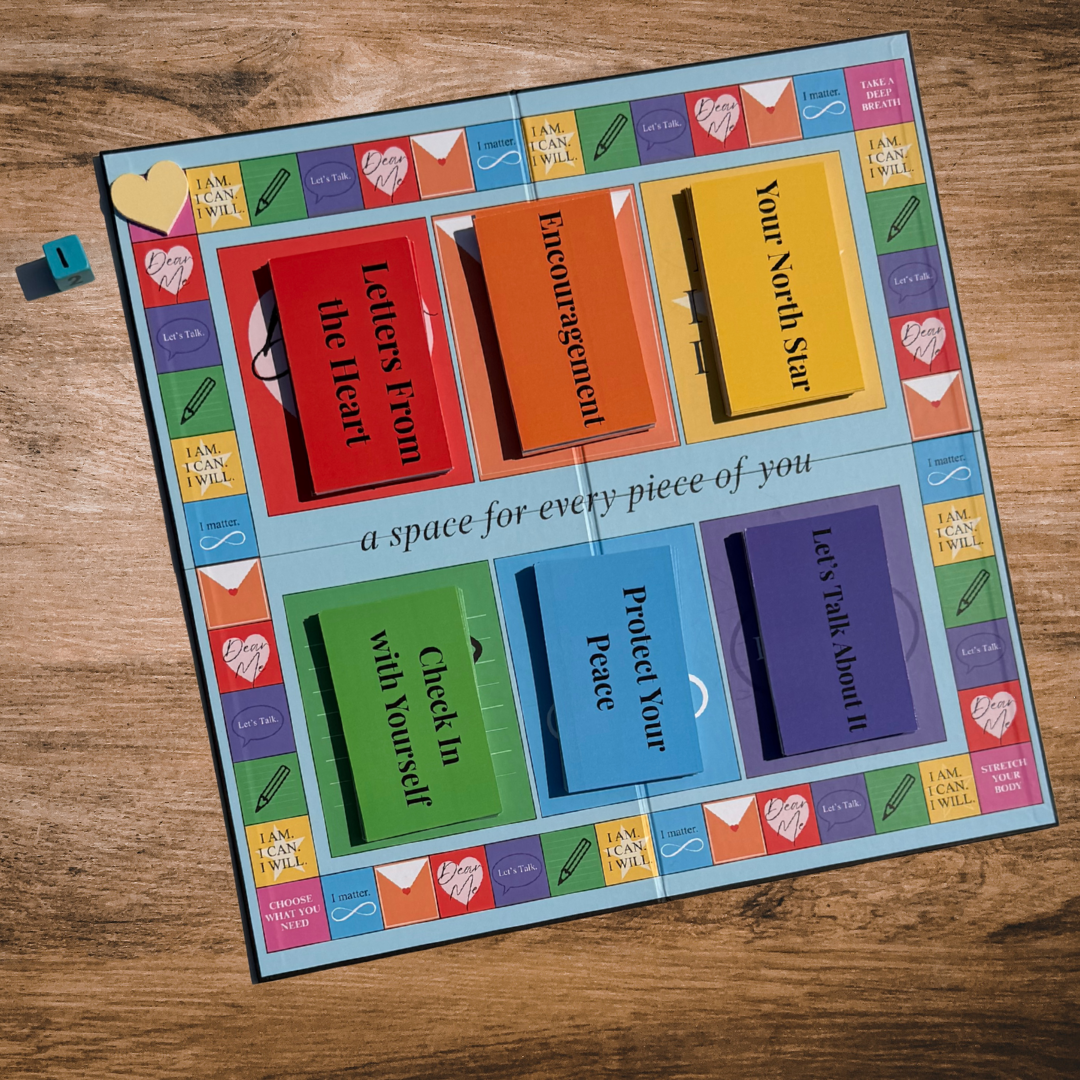
Pieces of You™ is more than a board game; it’s an opportunity for every individual at the table to discover a tool that supports their inner journey. The game contains 6 categories filled with different prompts that invite you to write a letter to yourself, make a card for someone else, write down a value or goal, do a journal prompt, share a self-care or boundary out loud, or lead a group discussion. Each category touches on both different themes and different approaches to exploration.
The Guided Edition is designed for treatment centers, therapy groups, and mental health programs. It combines structured prompts with interactive activities to increase engagement, participation, and peer connection in group settings. It’s the group activity that is actually meant for every member of the group.
This game can be incorporated into a variety of settings, including, but not limited to:
therapy groups
counseling sessions
individual reflection
structured therapeutic activities
Recommended Ages 16+
Learn More: Pieces of You: The Guided Edition — Francesca Reicherter
ALL BOARD GAMES HAVE A 4-6 WEEK TURNAROUND
© 2026 Pieces of You — All rights reserved. TM Pieces of You™ — Pending USPTO registration.
Disclaimer: Pieces of You™ is a reflective and discussion-based board game designed to foster self-expression, connection, and personal insight. It is not a form of therapy, treatment, or clinical intervention and is not intended to replace professional mental health care. The game was created by a facilitator, not a licensed therapist, and should only be used as a therapeutic tool under the guidance of a licensed mental health professional. Players should use the game at their own discretion and seek professional support if needed.