“How are you?”
It is probably one of the most common questions we ask each other, and one of the questions we answer on autopilot. “I’m good.” “I’m fine.” “Doing well.” We say it at work, with friends, when we run into someone we haven’t seen in months, and many times when we are barely holding ourselves together.
Lately, I’ve been thinking about how rarely we actually answer the question. Not because we are intentionally dishonest, but because we have become so accustomed to giving the socially acceptable answer that we sometimes forget to check in with ourselves first.
How often do you say “I’m fine” because explaining how you actually feel sounds exhausting? How often do you tell someone you’re having a good day because nothing is technically wrong, even though something inside you feels off? And how often do you know something is bothering you, but cannot quite put your finger on what it is?
I think emotional awareness begins with something much simpler than fixing ourselves: it begins with noticing.
I was recently in an adolescent psychiatric unit where I facilitated a group. One of the teens shared that as soon as he feels an emotion, like anger, his immediate response is to extinguish it. Get rid of it. Make it stop.
I understood exactly what he meant, because I feel that way too sometimes.
As a culture, we have decided that emotions that are not “happy,” comfortable, or convenient are inherently bad. We treat sadness like something we need to overcome, anger like something we need to suppress, anxiety like something we need to eliminate, and grief like something we need to move through as quickly as possible.
We see emotions as problems to solve instead of experiences that are part of being human. We also make them comparative.
I remember having a conversation with a friend where I was sharing how deeply devastated I felt about a situation I had no control over and the sense of loss I was carrying because of it. My friend, with good intentions, told me about someone else who had experienced a much bigger loss and reminded me that I should be grateful.
I knew the intention behind what they were saying was good, but instead of making me feel better, it created shame around my emotions. Suddenly, I wasn’t just experiencing loss. I was questioning whether I was allowed to experience it at all.
Emotions do not become invalid because someone else has experienced something worse. You can be grateful and devastated. You can love your life and still have moments when you are hurting. You can recognize that someone else has it harder and still acknowledge that something is hard for you. There is no emotional scoreboard where someone else’s pain determines whether yours is legitimate.
We are so quick to fight what we feel that sometimes we never stop long enough to understand it. For me, anger is a good example. A lot of the time when I feel angry, if I go deeper, I discover that I am actually afraid or disappointed. The anger is real, but it is not always the whole story.
There have been moments in my life when I felt angry enough that my first instinct was to lash out or isolate myself. But when I stopped and started journaling, I began asking myself different questions.
Where is this anger coming from?
What does this actually mean to me?
What am I protecting?
What am I afraid of losing?
Is this something I need to release, or is there something within me that needs comfort?
Those questions do not magically make the emotion disappear. That is not the point. The point is that I am giving myself enough space to understand what is happening before deciding what to do with it.
We are incredibly quick to solve our emotions. We feel anxious, so we distract ourselves. We feel sad, so we tell ourselves it could be worse. We feel angry, so we convince ourselves we are overreacting. We feel overwhelmed, so we keep pushing because there is still too much to do.
Sometimes, we do not even give ourselves enough time to figure out what we are feeling before we start trying to change it. An emotion does not have to be immediately resolved to be worth acknowledging.
You can simply say, “I am disappointed.” You do not have to follow it with, “But I shouldn’t be.”
You can say, “I am overwhelmed.” You do not have to immediately explain why you should be able to handle everything.
You can say, “I am lonely.” You do not have to convince yourself that you should be grateful instead.
Naming an emotion does not make it bigger. Sometimes, it makes it more manageable because you are no longer trying to understand something you have refused to identify. And this is where I think emotional awareness becomes so important. Your feelings are information. That does not mean every feeling is an objective assessment of reality. Our emotions can be influenced by our assumptions, past experiences, expectations, fears, and the stories we tell ourselves. But they are still worth listening to.
Frustration might tell you something is not working. Resentment might point toward a boundary you have ignored. Anxiety might tell you that something feels uncertain. Sadness might tell you that something mattered deeply to you. Relief might tell you that you finally released something you were carrying for too long.
Instead of asking, “How do I make this feeling go away?” try asking, “What is this feeling trying to tell me?”
That question creates room for curiosity instead of judgment. And oftentimes, curiosity is what we need before we need a solution.
So the next time someone asks how you are, you do not have to give them your entire emotional autobiography. You do not owe everyone access to every part of your internal world.
But before you answer, check in with yourself.
What am I feeling right now?
What happened that might be contributing to this?
Where do I feel it in my body?
What might be underneath this feeling?
What do I need?
And perhaps most importantly, what am I trying not to feel?
You might discover that you are not angry. You are hurt. You might realize that you are not lazy. You are exhausted. You might realize that you are not unmotivated. You are discouraged. You might realize that you are not “too sensitive.” Something actually mattered to you.
That distinction matters because you cannot respond to a need you have not acknowledged.
There is also a difference between acknowledging an emotion and allowing it to dictate your behavior. You can feel angry without lashing out. You can feel afraid without allowing fear to make every decision for you. You can feel disappointed without deciding that everything is hopeless.
Emotional awareness is not about becoming controlled by your emotions. It is about becoming aware enough of them that you can make intentional choices about what comes next.
I do not think every difficult emotion needs to become a five-step self-improvement project. A feeling can simply be a feeling.
There is so much pressure to constantly be improving ourselves, regulating ourselves, becoming more resilient, more productive, more positive, more emotionally intelligent. For me, the healthiest thing I learned to do is stop trying to turn every difficult emotion into a lesson before I have truly experienced it.
You are allowed to feel something without immediately turning it into a problem. You are allowed to have a bad day without making it evidence that your life is going badly. You are allowed to be confused. You are allowed to not know what you need yet. You are allowed to say, “I’m not sure how I feel.”
Honesty does not always mean having the answer; it is admitting that you are still figuring it out.
This month, I want you to practice checking in with yourself before automatically answering the question. Not because “I’m fine” is always a lie, but because sometimes it is simply the first answer that comes to mind.
Pause. Look a little deeper. Name what is there. And then ask yourself what you need.
“How are you?” (in my opinion) should be more than a greeting. It can become an invitation to actually listen to yourself.
This is also why I start every episode of my podcast by asking my guests, “How are you? Really?” It is not just an introduction or a question I ask because it sounds more meaningful than “How are you doing?” I want it to be an invitation for both of us to be honest.
When we create space for vulnerability, the conversation changes. We stop performing and start connecting. We share the parts of ourselves that make us human, not just the polished versions that are easy to present to the world. And I think we often forget that vulnerability is at the heart of connection. It is how we let someone else see who we are beneath the accomplishments, titles, experiences, and stories we usually lead with.
In my experience, the most meaningful conversations begin when someone finally feels safe enough to answer the question honestly. That is what I want Normalize the Conversation to be: a space where we can talk about what it actually means to be human, where we do not have to pretend everything is fine, and where being honest about what we feel creates the possibility of feeling a little less alone.
Journal Prompts & Reflections That Have Helped Me Go Deeper
When I need to slow down and understand what is happening beneath the surface, I come back to questions rather than immediately searching for answers.
What am I feeling?
What is underneath that feeling?
What happened before I started feeling this way?
What does this emotion need from me?
Am I trying to fix something that simply needs to be felt?
What do I need right now?
What would compassion look like in this moment?
These are the kinds of questions that have helped me create more space between what I feel and what I do.
My Pieces of You game and my How Are You? workbook are also tools I created to help make that space more intentional. They are not about finding the perfect answer or fixing how you feel. They are opportunities to slow down, explore what is happening beneath the surface, and give yourself time to understand, embrace, and respond to your emotions with a little more curiosity and compassion.
You do not always need to know exactly what is wrong. You just need to be willing to ask yourself what is there.
So, how are you? Really.

How Are You? © is a 30-day guided workbook designed to help you pause, check in with yourself, and build a daily habit of emotional awareness. Through prompts and creative exercises, it supports understanding how you feel, where those feelings come from, and how to offer yourself encouragement and care.
This workbook is designed to help younger kids to understand and communicate how they are feeling and their own experiences. It’s a great way for parents to open a line of communication that focuses on what the kid needs.
What This Workbook Supports
Over 30 days, this workbook helps you:
Check in with your emotions in a consistent, manageable way
Explore how you’re feeling using words, colors, and images
Understand what may be influencing or triggering your emotions
Identify small actions that can support you each day
Practice writing kind, encouraging statements for yourself
What’s Inside
This workbook includes:
30 days of guided “How Are You?” emotional check-ins
Creative emotion exploration using writing, color, and imagery
Journal prompts and “complete the sentence” exercises
Coloring pages and word-based activities to make reflection engaging and accessible
Daily encouragement to support motivation and self-compassion
All exercises are clearly guided, so you always know where to begin.
A Note from Francesca
When I created How Are You? ©, I wanted to make checking in with yourself feel simple, meaningful, and even a little comforting. It’s easy to overlook our feelings, but noticing and naming them is often the first step toward self-compassion and resilience.
This workbook is an invitation to pause each day and offer yourself the encouragement you deserve with care, curiosity, and kindness.
With love,
Francesca
Part of the Foundation Path. This workbook supports gentle daily check-ins and emotional awareness, helping build a consistent practice of understanding how you feel.
Next Step
If you’re ready to explore how your thoughts shape your feelings, Your Thoughts Matter © offers tools to reframe negative thinking into encouragement.
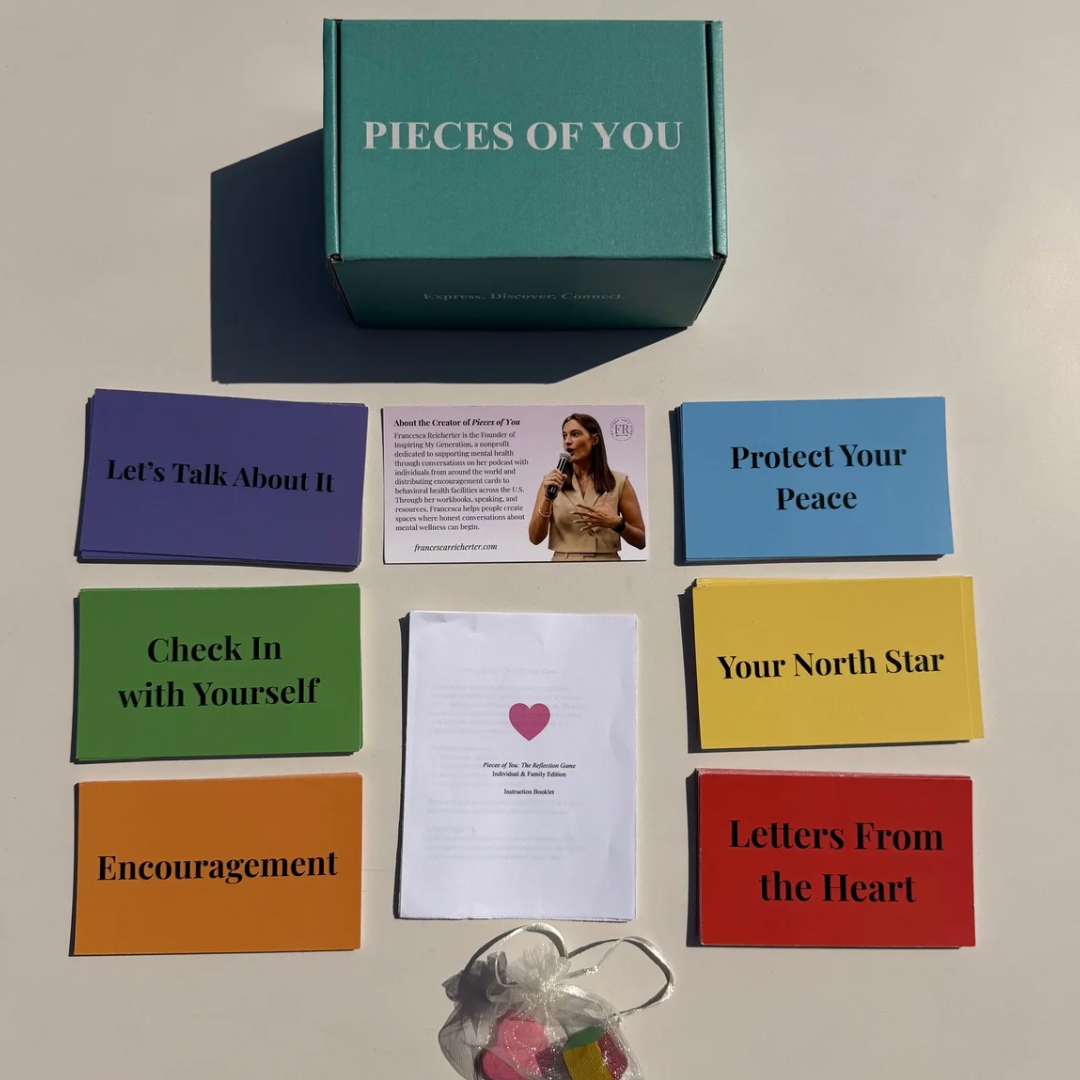
Pieces of You™ (Individual & Family Edition) is a card game containing six different categories of prompts to help you slow down, reflect, and connect. The game can help guide conversations while inviting you to explore your thoughts, emotions, values, and experiences in a thoughtful and supportive way.
You can use these cards:
for personal reflection
as journaling prompts
during meaningful conversations
with friends, family, or partners
Recommended for Ages 10+
Learn More: Pieces of You: The Individual & Family Edition — Francesca Reicherter
© 2026 Pieces of You — All rights reserved. Pieces of You™ — Pending USPTO registration.