Celebrating One Year at DiDi Hirsch: When Conversation Becomes The Intervention
One conversation can change the direction of someone’s life. The question is whether we’re creating enough opportunities for those conversations to happen.
Sometimes, the most significant breakthrough in one’s mental health and recovery journey begins with a single question no one has ever asked before. Healing doesn’t always come from advice or a standard protocol; it often begins with a moment of feeling truly seen and heard.
One year ago, on a Monday afternoon, I walked into DiDi Hirsch Excelsior House for the first time, and it changed my life forever. It was that day I realized: Behind every diagnosis, every addiction, and every crisis is a person whose story is waiting to be understood.
The first few weeks started out as creating Encouragement Cards with 20 prompts I had printed on paper. We talked about our responses and started to open conversations. It was around that time that I had made a quick board game with a patient I was seeing as a MFT trainee.
I couldn’t sleep that night because I had an idea. What if I took merged the arts and crafts component of the cards with intentional conversations and turned it into a game?
And one Monday, I walked in to DiDi Hirsch with a folded piece of paper with 120 printed prompts. It wasn’t yet a professionally designed board game with polished components. It was a hypothesis: If we created a space for thoughtfully designed conversation, then the conversation could become an intervention in itself.
Week after week, the game evolved alongside the patients who played it. Every session revealed a prompt that could be stronger, an activity that could be more engaging, or a conversation that could reach further. Their feedback shaped each revision until the experience became something far greater than a board game. It wasn’t just setting goals; it was creating your North Star on an actual star cutout. It wasn’t just saying kind words to yourself; it was a letter from your heart on an actual heart cutout. It was an experience where the takeaways lasted beyond treatment.
The most important component for me was that everyone at the table would be able to participate in a way that engaged their strengths. I knew that some individuals liked to color while others liked to journal or lead conversations. So, like how schools have multiple choice, essays, and oral presentations to give everyone a fair chance at a good grade, I adjusted my game to make sure everyone at the table had a tool they’d enjoy using to go deeper.
And eventually, my hypothesis turned out to be correct. The right questions, combined with interactive experiences that meet people where they are emotionally, can unlock years of silence. However, the most powerful intervention wasn’t just what we say; it was the space we created for everyone to feel seen and heard.
So, over the course of a year, those folded pieces of paper gradually turned into my debut game, Pieces of You™. At first, it was an activity I did in just that group, and the growth into the product that other facilities are using today happened naturally. (To be totally honest, it was the patients and a friend who repeatedly told me to trademark it and turn it a real game. They saw the widespread potential of helping people along their journeys, and repeatedly encouraged the expansion.)
Each week, within a single hour, people began changing the way they saw themselves. As they found the courage to tell their story, they also gave themselves permission to begin writing a new one. The narrative they had been living for so long, suddenly became just a chapter, and they were ready to turn the page.
I was so nervous my first few times walking in, and then suddenly, I’d walk in, and patients would run toward the door saying, “Fran’s back!” or calling it their “favorite group.” And by just showing up, I’ve witnessed moments that continue to shape the way I approach my own recovery journey.
One woman shared about her long history of meth addiction and the unhealthy relationship she continually sacrificed herself to maintain. After one session of reflecting on her values, goals, and the life she wanted to build, she made a decision that she wanted this time to be different. Instead of leaving treatment early to return to the same cycle, she chose to continue investing in her recovery. I got to witness someone recognize their own worth and choose themselves in real time.
Another patient began group by announcing he wasn’t going to “play a board game or do arts and crafts with a 12-year-old.” By the end of the session, he was leading one of the most vulnerable conversations, sharing through tears what it felt like to go from being a successful businessman to experiencing homelessness and wrestling with profound feelings of worthlessness. Resistance, which started as simply protection around the pain, turned into a moment where everyone at the table saw themselves in his story.
One gentleman who had been unhoused for more than forty years told me it was the first time he had ever participated in an arts and crafts activity since elementary school. When participants created encouragement cards filled with the words they wished someone had spoken to them years ago. It wasn’t “coloring,” it was an overlooked tool for healing his inner child.
Another patient admitted he didn’t know how to write an encouragement card because no one had ever given him encouraging words before. When the group exchanged cards, he received what he told me was the first message of hope anyone had ever given to him.
Those moments didn’t stay in the group; they followed people into their recovery. I’ve watched patients ask for tape after group so they could hang their hearts, North Stars, and encouragement cards on the walls of their rooms as daily reminders. I’ve received messages weeks and months later from patients telling me they still have those cards and continue returning to them on difficult days.
When I walked into DiDi Hirsch each week, my goal was not to simply create a board game, but to create experiences that extend beyond the hour we spend together. Conversations that linger, reflections that continue, and encouragement that someone carries with them long after the game is put away.
Playing my game each week has reminded me that healing begins with someone asking a thoughtful question, someone listening without judgment, or someone offering words another person has waited a lifetime to hear.
I’ve stopped thinking about Pieces of You™ as a board game. I see it as a framework for facilitating conversations that many people have waited years (even decades) to have. Every prompt, activity, and reflection was intentionally designed to help people move beyond surface-level discussion and toward greater self-awareness, emotional insight, and connection.
The game may have started as folded pieces of paper, but what was really being built wasn’t a board game; it was permission for people to be seen, heard, and understood. It was a space for healing.
To every patient who trusted me with your stories, challenged my assumptions, tested every version of this game, and reminded me why this work matters—thank you.
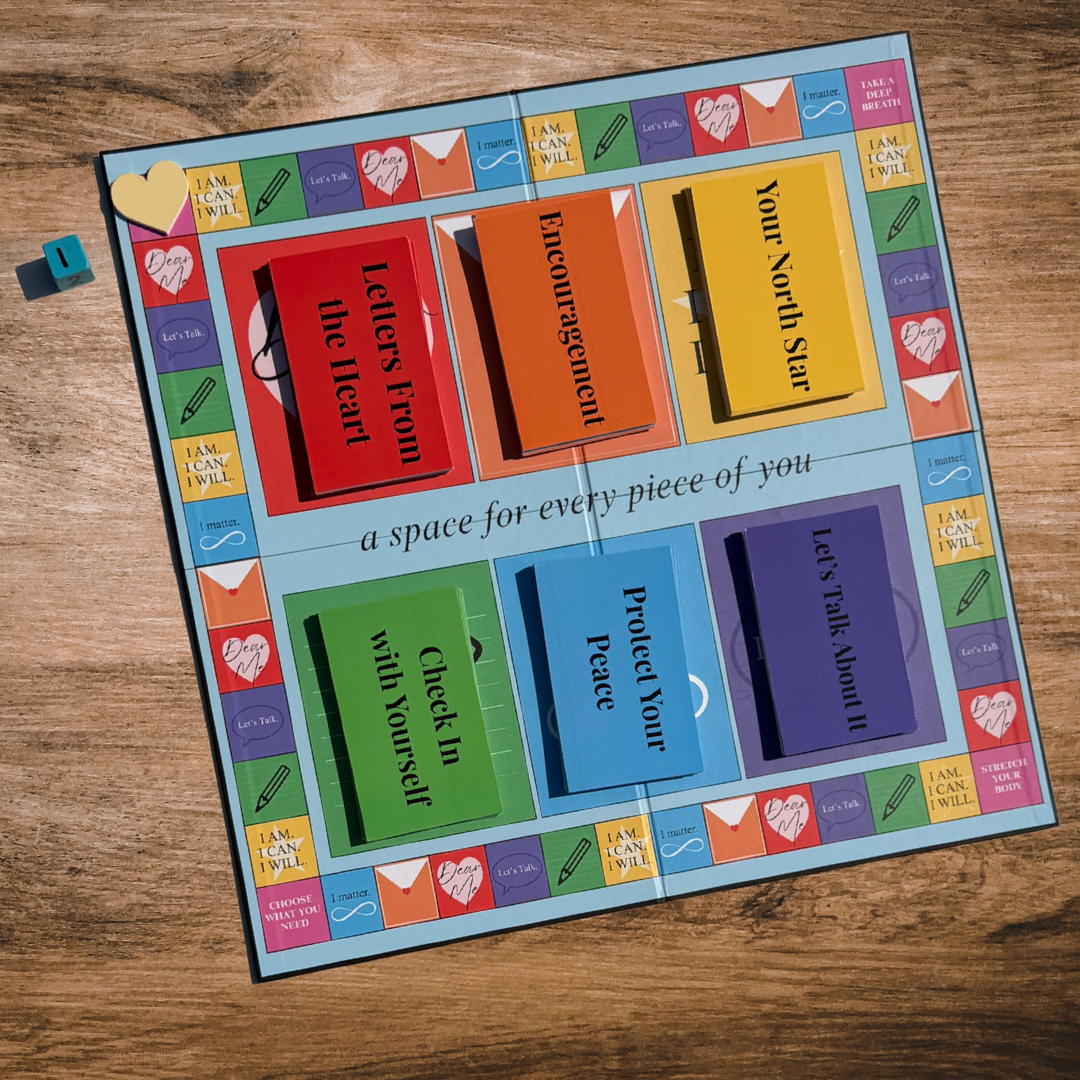
Pieces of You™ is more than a board game; it’s an opportunity for every individual at the table to discover a tool that supports their inner journey. The game contains 6 categories filled with different prompts that invite you to write a letter to yourself, make a card for someone else, write down a value or goal, do a journal prompt, share a self-care or boundary out loud, or lead a group discussion. Each category touches on both different themes and different approaches to exploration.
The Guided Edition is designed for treatment centers, therapy groups, and mental health programs. It combines structured prompts with interactive activities to increase engagement, participation, and peer connection in group settings. It’s the group activity that is actually meant for every member of the group.
This game can be incorporated into a variety of settings, including, but not limited to:
therapy groups
counseling sessions
individual reflection
structured therapeutic activities
Recommended Ages 16+
Learn More: Pieces of You: The Guided Edition — Francesca Reicherter
Product Ships in 4-6 weeks!
© 2026 Pieces of You — All rights reserved. TM Pieces of You™ — Pending USPTO registration.
Disclaimer: Pieces of You™ is a reflective and discussion-based board game designed to foster self-expression, connection, and personal insight. It is not a form of therapy, treatment, or clinical intervention and is not intended to replace professional mental health care. The game was created by a facilitator, not a licensed therapist, and should only be used as a therapeutic tool under the guidance of a licensed mental health professional. Players should use the game at their own discretion and seek professional support if needed.